Kappa and Meen Curry: Kerala Tapioca with Red Fish Curry
How to make kappa vevichathu and the fiery kudampuli red fish curry that goes with it, with safe peeling and double-boiling steps for tapioca.
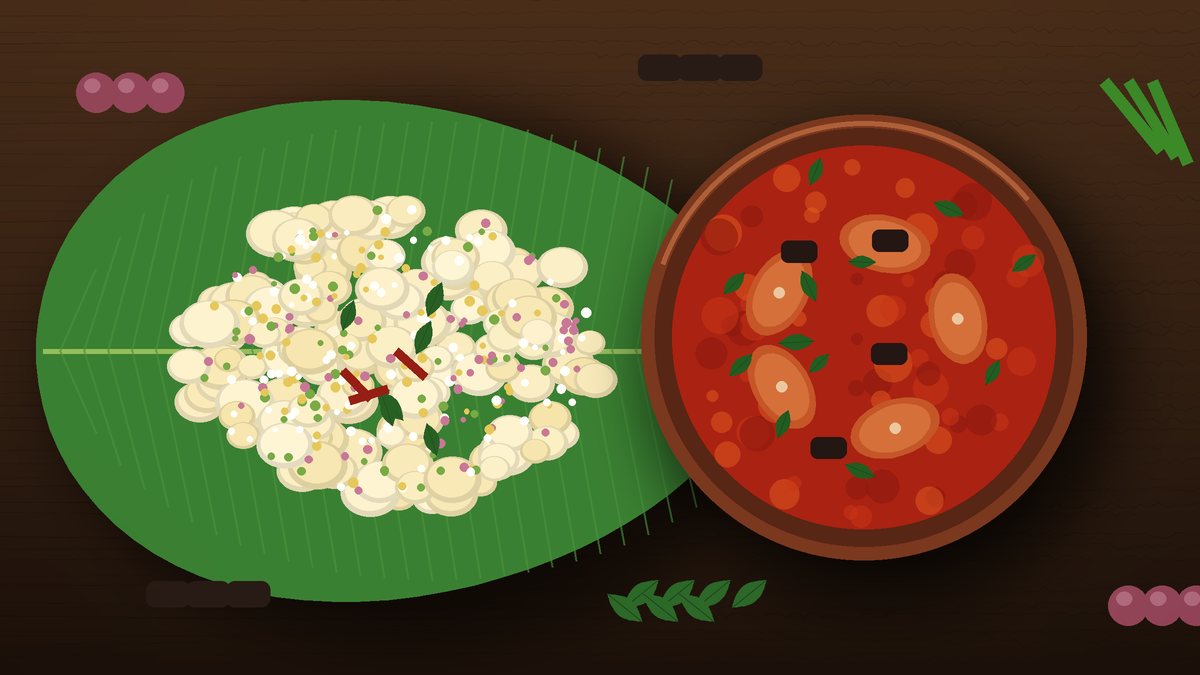
The short answer: the fish curry that goes with kappa is not the creamy coconut-milk kind. It is a fiery red meen curry, often called meen mulakittathu, soured with kudampuli and finished with raw coconut oil, ladled over boiled and mashed tapioca (kappa vevichathu) that has been folded with a coarse crush of coconut, shallots and chilli. Below is how to make both so they reach the table together, with the safety steps for peeling and boiling kappa that every Kerala kitchen follows.
Why kappa needs a sharp, red fish curry
Kappa is starchy, mild and slightly sweet. A rich coconut-milk curry such as our coconut meen curry is lovely with rice or appam, but on tapioca it simply adds more softness. Kappa wants contrast: heat from chilli, a deep sourness from kudampuli and the sharp edge of shallots fried in coconut oil. That is why toddy-shop menus and Sunday lunches across Travancore and central Kerala pair the two.
The pairing has a history too. Tapioca came to Kerala from South America and was promoted in the erstwhile Travancore state in the late nineteenth century, credited to Vishakham Thirunal, as a food crop to protect people from famine. It became a true staple during the Second World War, when rice imports from Burma stopped (The Hindu).
At a glance
- Serves: 4
- Total time: about 75 minutes (the curry can be made a day ahead)
- Best fish: sardine (mathi), mackerel (ayala), seer fish (neymeen) or tuna (choora) steaks
- Pot: a manchatti (clay pot) if you have one, otherwise a heavy-bottomed pan
Part 1: Kappa vevichathu (boiled, mashed tapioca)
Ingredients
- 1 kg fresh tapioca (kappa)
- 1 tsp salt, plus more to taste, and 1/2 tsp turmeric powder
- For the crush: 3/4 cup grated coconut, 5 shallots, 3 green chillies (or 4 dried red chillies), 2 garlic cloves, 1/2 tsp cumin seeds, a few curry leaves
- To temper: 1 tbsp coconut oil, 1/2 tsp mustard seeds, 2 dried red chillies, 1 sprig curry leaves
Peel and boil kappa safely
Tapioca (cassava) naturally contains cyanogenic glycosides, which is why it must never be eaten raw. Food-safety regulators require cassava to be sold with a note that it must be peeled and fully cooked (FSANZ), and Hong Kong's Centre for Food Safety notes that the sweet varieties sold for cooking are made safe by peeling and thorough cooking, with cutting into small pieces and boiling in water being particularly effective (CFS). The Kerala habit of boiling once, throwing that water away and cooking again in fresh water does exactly this.
- Cut the roots into 3-inch logs. Run a knife lengthwise through the skin and peel away both the brown outer bark and the thick pinkish layer under it.
- Cut into 1-inch cubes and pull out the woody string in the centre. Rinse well.
- Cover with plenty of water, boil for 10 minutes, then drain and discard the water.
- Add fresh water, the salt and turmeric, and cook until a fork slides through and the edges start to crumble, 12 to 20 minutes depending on the roots. Drain thoroughly. If a cooked piece tastes bitter, discard that batch.
Mash and season
- Pulse the crush ingredients without water until it looks like damp sand, not a paste.
- Return the hot kappa to the pot over low heat, add the crush and break the cubes roughly with a sturdy spoon. Leave some chunks; smooth kappa turns gluey.
- Cover for 3 to 4 minutes so the steam softens the raw shallot and chilli.
- Heat the coconut oil, splutter the mustard seeds, add the red chillies and curry leaves, and pour over the kappa.
Part 2: The red fish curry for kappa (meen mulakittathu)
Ingredients
- 500 g fish steaks or whole cleaned sardines or mackerel, scored
- 3 to 4 pieces kudampuli, rinsed and soaked in 1/2 cup warm water for 15 minutes
- 3 tbsp coconut oil, plus 1 tsp to finish
- 1/2 tsp mustard seeds and 1/4 tsp fenugreek seeds
- 12 shallots, sliced (or 1 small onion)
- 1 1/2 tbsp chopped ginger and 8 garlic cloves, sliced
- 3 green chillies, slit, and 2 sprigs curry leaves
- 3 tbsp Kashmiri chilli powder and 1 tsp hot chilli powder (adjust to taste)
- 1/4 tsp turmeric powder, 1 tsp coriander powder (optional), salt
- 1 1/2 cups water
Method
- Make a chilli paste. Mix the chilli powders, turmeric and coriander with 4 tbsp water. Adding powders as a paste stops them scorching in hot oil.
- Temper. Heat the oil in the manchatti, splutter the mustard seeds, then add the fenugreek and let it turn just golden. Dark fenugreek makes the whole curry bitter.
- Build the base. Add the shallots, ginger, garlic, green chillies and curry leaves. Saute for 5 to 6 minutes until the shallots are soft and brown at the edges.
- Fry the paste. Lower the heat, add the chilli paste and cook for 2 to 3 minutes, stirring, until it darkens and oil separates at the sides. This step decides whether the curry tastes deep or raw.
- Sour and season. Add the kudampuli with its soaking water, the water and salt. Boil for 5 minutes until the gravy thickens slightly.
- Add the fish. Slide the pieces in a single layer. Do not stir; swirl the pot by its rim instead. Cover and simmer for 8 to 12 minutes (sardines need less time than seer or tuna steaks).
- Finish and rest. Drizzle 1 tsp raw coconut oil, scatter a few curry leaves, cover and switch off. Rest for at least an hour. The curry is noticeably better the next day, which is why many homes make it the night before.
Timing both dishes for one meal
Start the curry first: soak the kudampuli, make the curry and leave it to rest. While it rests, peel, double-boil and season the kappa. Serve the kappa hot in a mound on a plate or banana leaf, make a small well and spoon the curry and a fish piece into it so the red gravy soaks the edges.
Kudampuli, kokum or tamarind?
Kudampuli (Malabar tamarind, Garcinia gummi-gutta) is the black, smoky dried fruit used in central Kerala fish curries, and it is what gives this curry its rounded sourness. Kokum (Garcinia indica) is a related but different fruit used more along the Konkan coast; it is fruitier and lighter. If you have neither, stir in 1 tbsp thick tamarind extract at the end of step 5. It will taste good, just not the same.
Common mistakes and quick fixes
- Curry tastes harsh or powdery: the chilli paste was not fried long enough before the water went in.
- Bitter curry: burnt fenugreek or too much kudampuli. Remove the kudampuli pieces if you are keeping the curry beyond a day.
- Fish breaks apart: it was stirred. Swirl the pot instead.
- Gluey kappa: overcooked or mashed too much. Stop when the edges crumble.
- Hard kappa that will not soften: old roots. Buy firm, freshly dug roots with clean white flesh and no dark streaks.
What else goes with kappa
The other famous partner is beef: try kappa with our beef ularthiyathu. Kappa is also good with Kerala prawn masala, and for a weekend spread, add a karimeen pollichathu. Browse more ideas in our Kerala recipe collection.
Frequently asked questions
Is kappa the same as tapioca or cassava?
Yes. Kappa is the Malayalam name for the cassava root, sold as tapioca in India. In parts of Thiruvananthapuram it is also called maricheeni.
Can I use frozen kappa?
Yes. Frozen peeled tapioca sold in Gulf and other supermarkets works well. Cook it from frozen in plenty of water until fully tender, drain, then season as above.
How long does the fish curry keep?
Cooled and covered, it keeps for up to 2 days in the fridge. Reheat gently once, without stirring, until piping hot.
Sources
- The Hindu, "How tapioca came to Travancore" (27 June 2019).
- Food Standards Australia New Zealand, "Cassava" (consumer guidance on cyanogenic glycosides).
- Centre for Food Safety, Hong Kong, "Cyanide Poisoning and Cassava", Food Safety Focus, issue 19.