How to Serve a Kerala Sadya on a Banana Leaf: What Goes Where
Which way the banana leaf faces, where each sadya dish goes on the upper and lower half, the order of the courses from parippu to payasam, and how to fold the leaf.
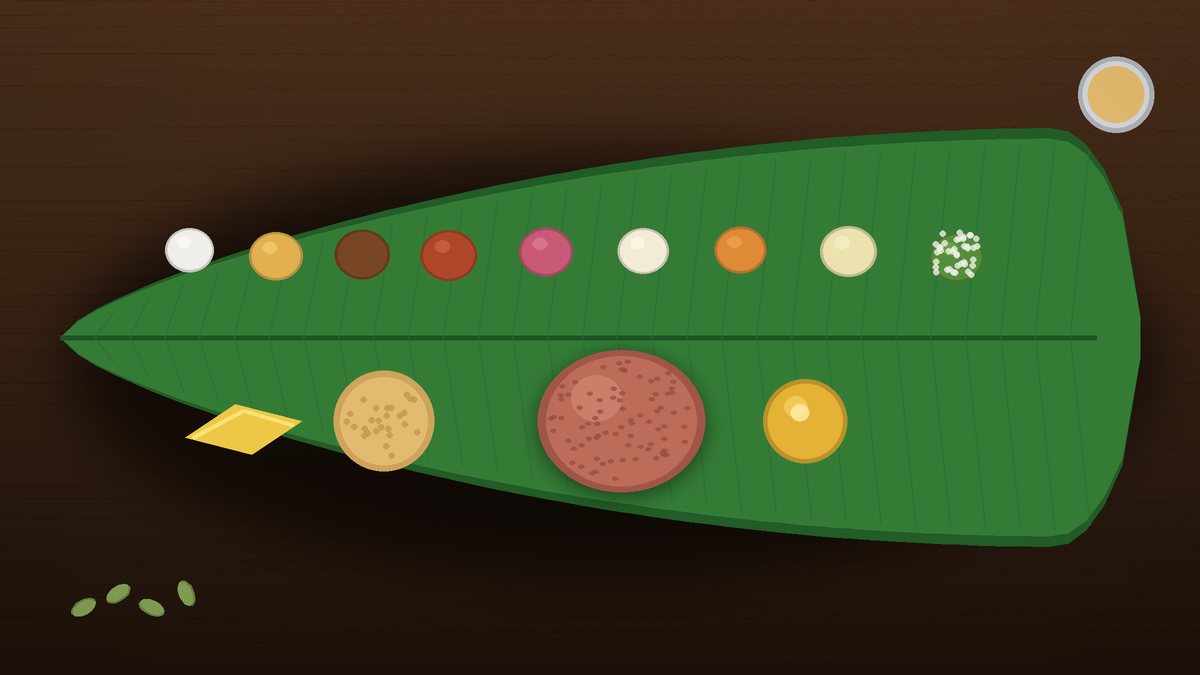
The short answer: lay the banana leaf in front of the diner with its narrow tip pointing to the left. Serve the small items on the upper half, working from left to right: salt, banana chips, sharkara upperi, pickles, pachadi and kichadi, then the dry thoran and the wet curries such as olan, erissery and avial. Pappadam and a ripe banana go on the lower half. Rice comes last, after all the side dishes are on the leaf, and the meal then runs course by course: parippu with ghee, sambar, then pulissery or moru, and finally payasam. When you finish, fold the leaf toward yourself, where that custom applies.
That is the common Central Kerala way, and it is the version most guides describe. Families, caterers and regions differ in the details, so treat it as a dependable default rather than a rule that cannot bend. If you already know the dishes and only need to place them, this page is for you. If you still need the menu itself, start with our complete Kerala sadya menu and come back here for the layout.
Start with the leaf
Use a fresh, tender leaf. Place it on the table or mat horizontally in front of the diner with the narrow, tapering tip to the left and the glossy side up. This is the one point on which every guide we checked agrees: a cook writing about Kottayam-style sadya, a homeware brand and a caterer's explainer all say the tip faces the left of the person eating.
The leaf's midrib then divides it in two. The upper half, the side farther from the diner, holds the small, strongly flavoured items. The lower half, nearest the diner, is where the rice and the main courses land.
The upper half, left to right
Servers start at the tip end and move toward the right, so the order below is also the order in which the dishes arrive. Wikipedia notes that the dishes go to fixed spots so that waiters can see at a glance which item has run out and top it up. Pickles at the top left and the banana at the bottom left are its examples.
- Salt. A pinch, always first, at the far top left.
- Banana chips (upperi) and sharkara varatti. The thin salted chips and the jaggery-coated ones, which are the crunchy pair. Our banana chips recipe covers the salted kind.
- Inji curry (puli inji) and pickles. Sweet-sour ginger relish, then mango and lime pickle. These are the sharp, small spoonfuls that wake up the palate.
- Pachadi and kichadi. The curd-based, mildly sweet or tangy side dishes made with beetroot, pineapple, cucumber or okra.
- Olan, erissery and kaalan. The gentler coconut-based curries. Olan is pale and light, erissery is thicker and sweeter with a roasted coconut finish.
- Avial and thoran. Avial and a dry stir-fry such as cabbage thoran sit toward the right end. One cook's guide ends the top row with the thoran at the far right.
The sources differ a little on exactly which wet curry sits next to which, and on whether the ripe banana belongs in the top row or the bottom-left corner. That is normal. What stays constant is the logic: dry and sharp things at the left, soft coconut curries in the middle, and room left on the leaf for the rice.
The lower half: pappadam, banana and rice
Pappadam goes on the lower left, alongside the banana in the layouts that put it there. Then the rice. It is served after the side dishes, as a mound at the lower centre, and the traditional choice is red parboiled Kerala matta rice. The courses that go with the rice, parippu, sambar and the rest, are served onto or beside the mound as each round comes by.
That is why a good server leaves the lower centre free until it is time. A crowded leaf with rice already down leaves no space for the main curries.
The order of the courses
A sadya is eaten in stages. The leaf is not a buffet to be mixed all at once.
- Rice with parippu and ghee. The first course, eaten with a little pappadam. The dal is plain and mildly spiced, and the ghee is poured over it. See our parippu curry for how it is made.
- Rice with sambar. The tamarind-lentil curry, eaten with the thoran, avial and other side dishes. Our Kerala sambar is the version for this course.
- Rasam, pulissery or moru. Some guides place rasam here, and others do not mention it at all, as the cook from Kottayam notes: it varies by household. The sour course is pulissery or spiced buttermilk (moru curry). Wikipedia notes that buttermilk is typically served near the end of the savoury meal.
- Payasam. Usually two or more kinds, often one jaggery-and-coconut-milk payasam and one milk-based. Ada pradhaman and palada payasam are two popular choices.
Servers go round with each course and top up whatever has run out, so a diner can say yes or no to a second helping at every round.
How to eat: hands, seating and the closing fold
- Seating. Traditionally people sit cross-legged on mats in a row (a pankthi), all served together. Wikipedia notes that sadya is now often served on tables, as many people no longer find the floor convenient.
- Eating. With the right hand only, no cutlery. Wikipedia describes cupping the fingers to form a small ladle.
- The fold. When you finish, fold the leaf over. According to Wikipedia, in some places closing it toward you signals that you were satisfied, while folding it away from you suggests the meal could have been better. It adds that the meaning of the fold can differ between regions of Kerala, so if you are a guest, follow your hosts and do not assume a message.
Mistakes to avoid
- Leaf turned the wrong way. With the tip to the right, the upper-half and lower-half layout above no longer lines up with how guests expect to eat.
- Rice first. If the rice is down before the side dishes, the order of the courses and the space for the curries both break down.
- Everything piled together. Small portions on the upper half work better than heaping spoons. A server can always return.
- Forgetting the vegetarian rule. A traditional sadya has no onion or garlic, and no meat or fish. Keep to that for a festival or temple sadya.
- Overloading the menu. A typical sadya has around 24 to 28 dishes according to Wikipedia, but you can cook a far smaller one. Eight to twelve well-made items still serve the order of the leaf.
A scaled-down home sadya on one leaf
If you are hosting a small family sadya, one workable plan for a single leaf is this:
- Upper half: salt, banana chips, one pickle, one pachadi, olan or erissery, avial and a thoran.
- Lower half: pappadam, a ripe banana, and a mound of rice served only when the side dishes are in place.
- Courses: parippu with ghee, then sambar, then moru, then one payasam.
That is ten items, it fits on one leaf without crowding, and it still follows the structure above. Cook the dry and room-temperature items first, the curries next and the rice last, so everything is hot and ready as the leaf is laid.
Frequently asked questions
Which way should the banana leaf face for a sadya?
The narrow tip points to the left of the person eating, with the glossy side facing up. The wide end then lies to the right.
Where does the payasam go on the leaf?
Payasam is the final course, so it arrives last. Depending on the host it is served on the leaf or in a small cup or glass beside it.
Can I use a plate instead of a banana leaf?
Yes. A steel plate or thali works for a home meal. Keep the same logic: small dishes along the upper edge, pappadam at the lower left and the rice in the middle. A leaf is still the traditional choice for a festival sadya.
Is the order the same everywhere in Kerala?
Not exactly. Wikipedia notes that the Central Travancore sadya is considered the most tightly bound to tradition, and that other regions follow their own serving styles. The layout above is the common core.
Sources
- Sadya (Wikipedia): dishes served in fixed spots, pickles top left and banana bottom left, buttermilk near the end, leaf fold meanings, eating customs.
- Onam Sadya Recipes and How to Serve a Kerala Sadya (Cooking and Me): leaf direction, serving order and the course sequence, with the author's note on regional differences.
- Onam Sadya at Home: How to Set an Authentic Banana Leaf Table (ellementry): upper and lower halves of the leaf and the placement of the rice, pappadam and curries.
Looking for the full menu and what to cook? Read the Kerala sadya guide and pick one curry, one thoran and a payasam from our recipes to start.